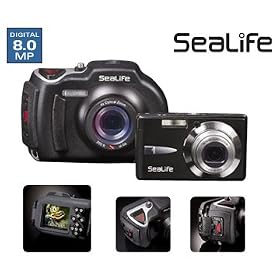
 I recently bought this camera at a local dive shop and was able to use it on a dive and a couple snorkel trips in Hawaii.
Previously, I was using an underwater camera bag (~$30) with a Sony DSC-V1 (5MP pro-sumer) to take snorkeling photos.I was able to get some great photos in the process.Unfortunately, that solution made it difficult to operate the camera, sometimes the bag plastic would warp/defocus the shot, and was a bit risky.I would also not be willing to take it on Scuba dives.The Sealife was an upgrade to improve on some ofthese shortcomings.
Using the camera underwater is very easy.The camera case feels good in your hands and very sturdily built.It is simple to operate and you can cycle quickly between photo mode/movie mode/review last shot with a single button, which is nice.The focus and shutter is reasonably quick for a small digicam, but of course it will require more time take shots than a DSLR.I am relatively new to diving (<15 dives), so the small size is perfect and won't encumber you like a larger setup might.Great for amateurs.
Underwater image quality was good and even though the Sealife uses a compact digicam-sized lens, it does pretty well.Lens speed is a key issue if you're just getting into underwater photography--available light disappears quickly as you decent only a few meters and most often you'll only be able to go as fast as a 1/30 sec or 1/60 sec shutter with this camera.Since you won't be using a tripod down there, expect many shots to come out blurry and forget about getting good photos of frightened fish.This is not something specific to the Sealife.My Sony V1 was similar even with a larger, lightly faster lens.Still, with a little patience and a steady hand, you'll get a few nice shots.
The wide-angle of this lens is great for getting some more interesting macros or better composed shots.I appreciated it when a sea turtle surprised me over my shoulder and I still was able to fit him in the frame only 18 inches away!The 4x optical zoom looks good, though you'll really need to hold steady.Movie quality is adequate and a nice bonus to have for fun.
The camera's underwater mode uses a preset white-balance (like a red filter), which can be manually readjusted if needed.It performs well in 5ft or deeper water, but will overcompensate close to the surface.This is mainly something to be aware of while snorkeling.The preset white-balance will be nice if you're not familiar with doing color corrections in photo-editing software (like photoshop).
The battery life was awesome.I was able to use the camera continuously for 3 separate snorkel trips without even thinking about the battery.I didn't even need to bother bringing the wall charger on the trip (though I did).
Above water, the Sealife is an "OK" compact camera but I found image and color quality to be slightly worse than my 3MP Canon Digital Elf.The Sealife's resoultion at 8MP is higher, but does not make a big difference.I also found that the Sealife had a difficult time focusing in many low-light or indoor conditions.If you have a decent alternative available, you'll want to bring that along for your nightlife or trips around town.
In summary, I'd recommend the Sealife DC800 to beginning to intermediate divers/photographers.If you are just starting out with underwater photography, a camera bag (like a DiCAPac) can be a cheap way to test your skills and interest on a snorkel trip.When you're ready to make another investment, the Sealife is a good next step before more expensive equipment.Even more seasoned underwater photographers may like having the Sealife around after you've moved on--it's small enough that you can take it on any dive if you don't want to lug around larger equipment.
See more reviews about: Sealife DC 800 8.0 Megapixel Underwater/Land Camera in Removable Housing with 4X Optical Zoom and 2.7-Inch LCD screen (Black)
Sealife DC 800 8.0 Megapixel Underwater/Land Camera in Removable Housing (Black) Review
Posted by Cameras Review | 18:42 | 0 comments »
Subscribe to:
Post Comments (Atom)
0 comments
Post a Comment